Research Vision & Focus

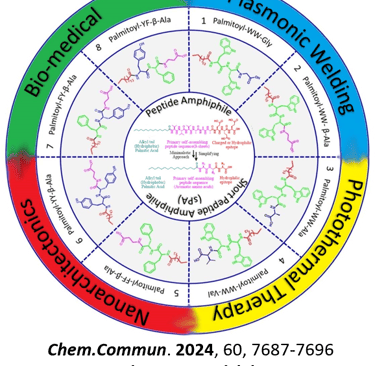
         Driven by the vision of “Tailored Peptide Conjugates for Diverse Applications,” our research integrates principles of supramolecular chemistry, nanoscience, and molecular engineering to design functional peptide-based systems with precise structural and physicochemical control. By exploiting the inherent self-assembling capability of minimalistic peptide motifs, we develop adaptive nanomaterials that bridge fundamental science with real-world applications. Our work emphasizes a structure–function-guided approach, enabling the transformation of simple molecular building blocks into sophisticated, stimuli-responsive platforms. These engineered systems are explored across interdisciplinary domains, including nanoarchitectures, energy materials, biomedicine, and environmental sustainability, with the overarching goal of addressing pressing societal challenges through innovative and scalable chemical solutions. The following sub-topics of our current research endeavors provide a brief overview of these focus areas; further details are presented below.

1. Advanced Peptide-Based Nanoarchitectures

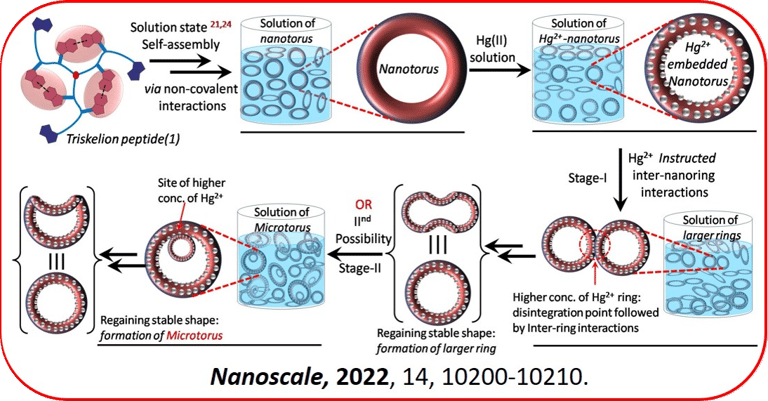
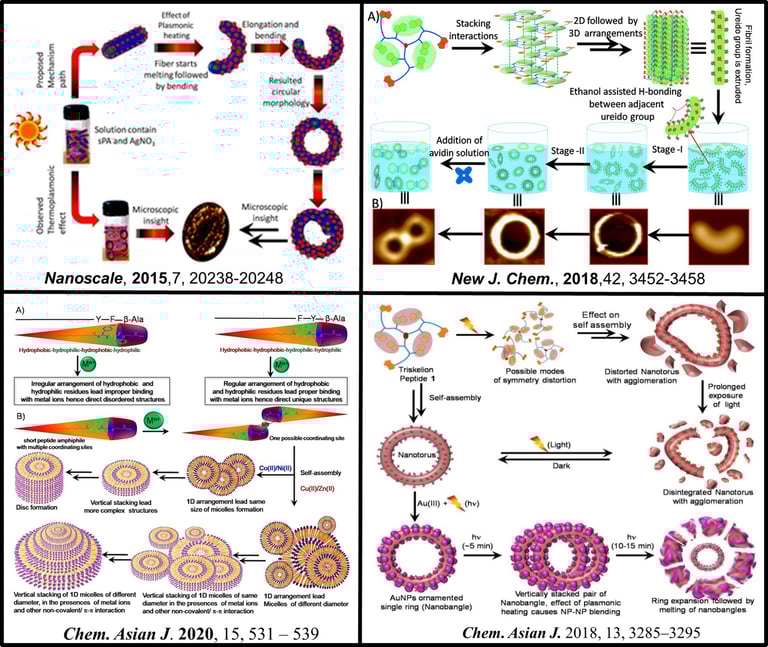
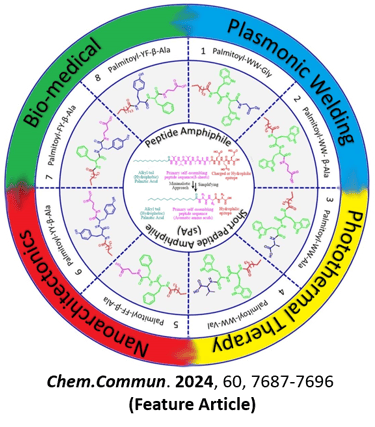
Our research focuses on the rational design and self-assembly of short peptide conjugates into well-defined nanoarchitectures with tunable morphology and function. By leveraging non-covalent interactions such as hydrogen bonding, π–π stacking, and hydrophobic effects, we engineer diverse nanostructures including nanofibers, nanorings, nanobangles, and nanodomes. These architectures are not merely structural motifs but serve as functional platforms with controllable physicochemical properties. A key emphasis lies in understanding the structure–property relationship that governs their stability, responsiveness, and interaction with external stimuli. Such peptide-based systems offer advantages of biocompatibility, modularity, and ease of functionalization, making them highly suitable for next-generation nanomaterials. This research opens avenues for designing adaptive and hierarchical materials with precise control at the molecular level, contributing significantly to the fields of supramolecular chemistry and nanoscience.

2. Peptide-Driven Energy and Photothermal Systems

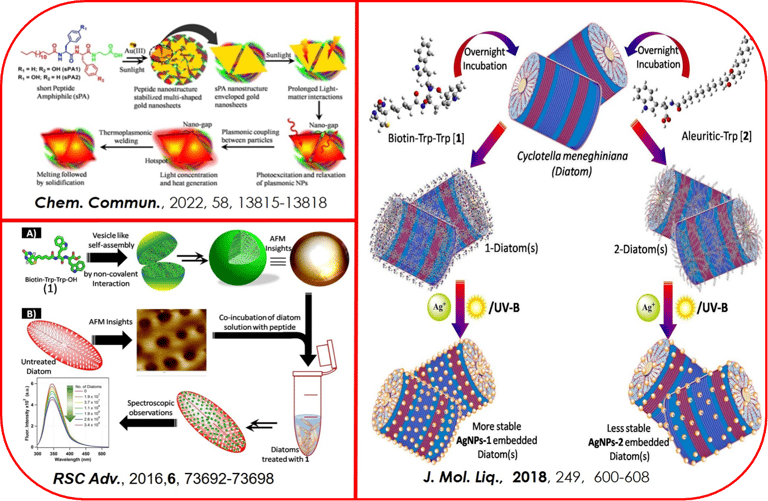
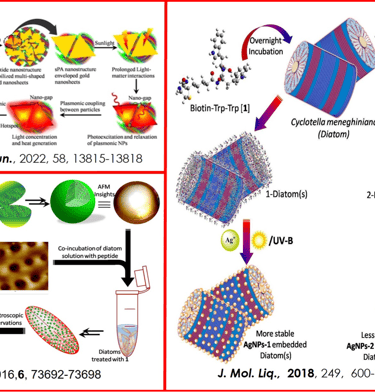
     We explore innovative energy-related applications of peptide conjugates, particularly in thermoplasmonic heating and hybrid energy conversion systems. By integrating peptide assemblies with plasmonic nanostructures, we develop materials capable of efficient light-to-heat conversion under controlled conditions. These systems exhibit enhanced photothermal efficiency due to the synergistic interaction between organized peptide frameworks and metallic nanostructures. Additionally, peptide–diatom hybrid systems are investigated for their role in dye-sensitized solar cells (DSSC), where biomolecular scaffolds improve light harvesting and charge transport. Our approach emphasizes sustainable and bioinspired design principles, utilizing minimalistic peptides to construct functional energy materials. This research not only contributes to renewable energy technologies but also provides a deeper mechanistic understanding of energy transfer processes at the nanoscale, paving the way for environmentally friendly and cost-effective energy solutions.

3. Biomedical Applications: Smart Therapeutics and Antimicrobial Systems

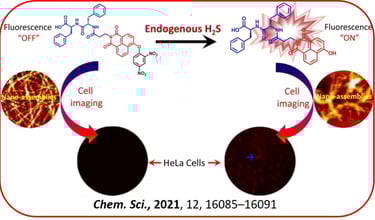
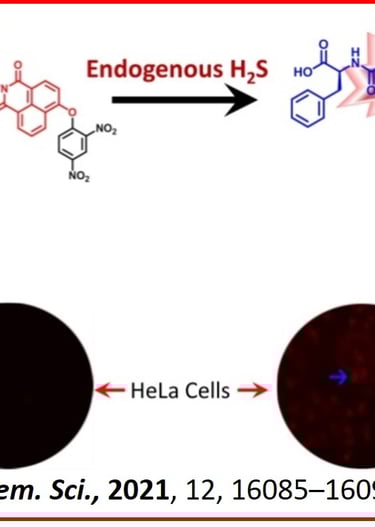
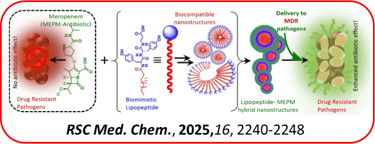
     A major thrust of our work lies in developing peptide-based nanoplatforms for biomedical applications, particularly in antimicrobial therapy and targeted drug delivery. We design stimuli-responsive peptide conjugates capable of encapsulating and releasing therapeutic agents under specific biological conditions, such as pH or H₂S-triggered environments. These systems demonstrate enhanced efficacy against drug-resistant pathogens, including MRSA, by facilitating membrane penetration and localized drug action. Furthermore, peptide assemblies are engineered to mimic host defense peptides, offering a novel strategy to combat antimicrobial resistance. Beyond antibacterial applications, our research also explores peptide-mediated imaging, diagnostics, and controlled drug release systems. The integration of bioactive molecules with peptide nanostructures enables multifunctionality, improved biocompatibility, and reduced toxicity. This work contributes to the development of next-generation nanomedicine platforms with high precision and therapeutic potential.

4. Environmental Applications: Sensing, Detoxification, and Sustainability

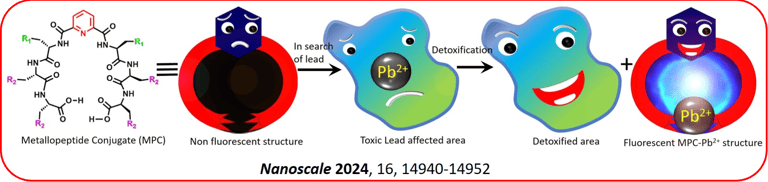
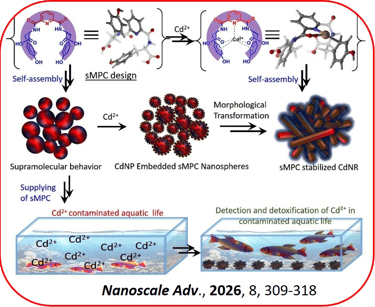
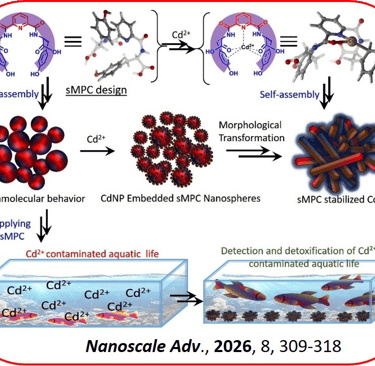
       Our research extends to environmental remediation through the development of peptide-based systems for sensing and detoxification of hazardous substances, particularly heavy metals. By designing functional peptide conjugates with selective binding affinity, we create nanosystems capable of detecting and capturing toxic ions such as, Hg²⁺, Pb²⁺ and Cd²⁺ in aqueous environments. These materials exhibit high sensitivity, selectivity, and rapid response, making them suitable for real-time environmental monitoring. Additionally, self-assembled peptide frameworks are employed for detoxification through sequestration and immobilization of pollutants. The modular nature of peptides allows for fine-tuning of their interaction with contaminants, enabling efficient removal strategies. This research aligns with sustainable chemistry principles, offering eco-friendly and biodegradable alternatives to conventional materials. Ultimately, our work aims to address critical environmental challenges by integrating nanotechnology, chemistry, and biology to develop smart and responsive remediation systems.